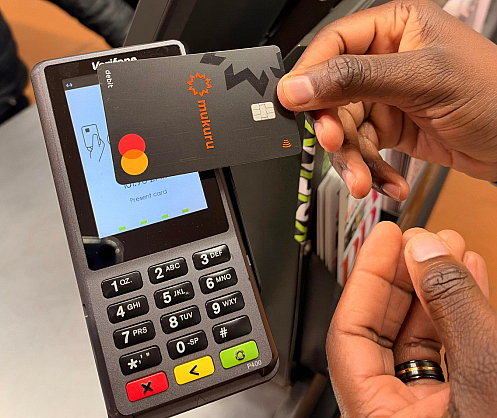


For many African financial institutions, card management is still treated as a back-office issuing function: produce cards, manage BINs, process transactions, and handle settlement. That view is becoming outdated. In today’s market, modern card management is no longer only about debit, credit or prepaid cards. It is becoming the foundation layer for digital-first experiences such as mobile banking, wallets, tokenised payments, real-time cardholder fraud controls and ecosystem partnerships.
The question for banks is no longer whether they can issue cards. It is whether their infrastructure can support the next decade of customer expectations.
Africa’s payments shift is accelerating
Africa’s payments market is moving faster than the systems many institutions still depend on. Mobile money has become a mainstream across the continent. According to GSMA’s, more than $2 trillion flowed through mobile money globally in 2025, with $1.4 trillion transacted in Sub-Saharan Africa alone.
Instant payments are following the same direction. AfricaNenda’s SIIPS 2025 report shows that 36 instant payment systems now live across 31 African countries from Ethiopia with the recent launch of the national system to Somalia SOMQR to other countries. Collectively, these systems processed 64 billion transactions worth nearly $2 trillion in 2024. Half of Africa’s instant payment systems now support cross-domain transactions across banks, mobile money operators and fintechs.
Financial inclusion is also becoming increasingly digital. Based on Global Findex 2025 data, the share of adults in Sub-Saharan Africa with either a bank or mobile money account rose from 34% in 2014 to 58% in 2024. By 2024, 51% of African adults had made or received a digital payment.
This creates both opportunity and pressure. African banking revenues reached about $99 billion in 2024 and were estimated at $107 billion in 2025, according to McKinsey. And the same analysis points to the next phase of competition being shaped by how banks scale digital capabilities and build revenue streams beyond traditional lending.
Why legacy card platforms are holding banks back
Many legacy card systems were built for a different banking era. They were designed around physical cards, batch processing, product silos, limited customer interaction and controlled release cycles. That model worked when the bank card was mainly a plastic payment instrument. It is less effective when the card is expected to work inside a mobile app, a wallet, a merchant ecosystem, a loyalty programme, an instant payment flow and a real-time fraud environment.
Legacy platforms create four major constraints.
- First, they slow product innovation. Launching a virtual card, changing card limits, connecting a wallet, adding a loyalty campaign or introducing a new corporate card proposition can require heavy customisation and long testing cycles.
- Second, they fragment customer experience. A customer may have a card, mobile banking account, wallet, loan, loyalty profile and fraud record sitting across separate systems. The bank sees pieces of the relationship, not the full picture.
- Third, they make integration harder. Fintech partnerships, open banking APIs, agent banking, merchant portals and national payment rails require systems that can communicate quickly and securely. Legacy infrastructure often adds layers of workaround rather than true connectivity.
- Fourth, they increase operational and fraud risk. Nigeria’s recent fraud data illustrates the challenge. NIBSS reported that digital payment fraud losses in Nigeria reached ₦52.26 billion by the end of 2024 and fraud continues to roam almost freely in the country, exploiting legacy system vulnerabilities, with e-commerce and internet banking remaining among the most affected channels through social engineering, insider abuse, SIM swap fraud, account compromise and phishing.
The modern card is now part of the digital banking experience
The modern card is no longer just a payment credential. It is a customer access point.
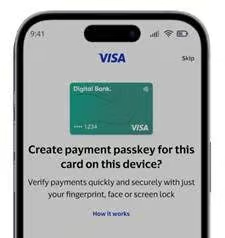
A card can now be issued instantly inside a mobile app. It can be tokenised into Apple Pay, Google Pay or a local wallet. It can be linked to spending controls, merchant categories, subscription management, loyalty, BNPL, corporate expense rules and real-time transaction alerts. It can be physical, virtual, disposable, account-linked, wallet-linked or embedded into a broader digital banking journey. This is why card management modernisation should not be framed as a narrow issuing replacement. It should be seen as an interoperable platform introduction decision.
A bank that modernises only the issuing layer may still fall into a legacy trap and be left with fragmented outdated fraud systems, separate digital channels, disconnected merchant services and slow integration into national rails. A bank that modernises around a unified stack can use card management as a gateway into a broader digital ecosystem.
What a modern platform should enable
The platform African banks should look for is not simply a card issuing engine. It should support a connected operating model across all channels – issuing, acquiring, switching, digital banking, e-wallets, fraud management, merchant services, APIs and integration with domestic payment infrastructure.
The core capabilities should include real-time processing, instant product configuration, virtual and physical card issuing, tokenisation, card controls, loyalty, dynamic pricing, BNPL support, multi-currency support, scheme connectivity, PCI compliance, ISO 20022 readiness, open APIs and integration with core banking, CRM, fraud and analytics systems.
This is where platforms such as BPC’s SmartVista reflect the broader direction of the market. Next-generation SmartVista card management is designed to support any type of modern card programmes with tokenisation standards and integration into core banking and customer systems. The important point is the architecture. Banks need modular, API-first, cloud-ready and real-time platforms that allow them to build continuously, not rebuild every time the market changes.
The strategic opportunity for African financial institutions
Modernisation is already happening in African markets, but the most useful examples show that success is not only about technology replacement. It is about connecting infrastructure to business outcomes. Few banks and payment systems are already on their modernisation journeys and show tangible results.
In Tanzania, CRDB Bank migrated issuing and acquiring systems to BPC’s SmartVista platform across Tanzania, Burundi and DR Congo. The project expanded card capabilities across corporate, virtual, proprietary, loyalty, fuel, hospital and international scheme cards, while connecting card services with Simbanking mobile banking and Wakala agency banking. More than 4.5 million cards have been issued through the upgraded platform.
In South Africa, GoTyme Bank modernised its issuing with BPC and integrated with kiosks and digital channels to support rapid customer onboarding and instant debit card issuance. The bank grew to more than 12 million customers and built a model that combines digital banking with in-person retail access.
In Ethiopia, EthSwitch launched the country’s National Instant Payment System on SmartVista, connecting 32 banks, 12 microfinance institutions, three payment system operators and three payment instrument issuers. The platform supports account-to-account and wallet-to-wallet transfers, interoperable QR, alias payments, recurring payments and merchant dashboards.
Banks need platforms, not patches
Africa’s financial institutions have a rare opportunity. They can avoid repeating the long technology cycles of older banking markets and move directly towards unified, digital-first infrastructure. But this requires a shift in thinking.
Card management should no longer be treated as a narrow issuing function. It should be viewed as a strategic control point and entry point for digital-first and mobile-first payments and ecosystem growth.
The banks that modernise now will be better positioned to launch faster, integrate more easily, protect customers in real time and compete in a market where payments are mobile, instant, embedded and data-driven. Those that remain in the legacy trap may still issue cards, but they will struggle to deliver the digital experiences African consumers and businesses already expect.