

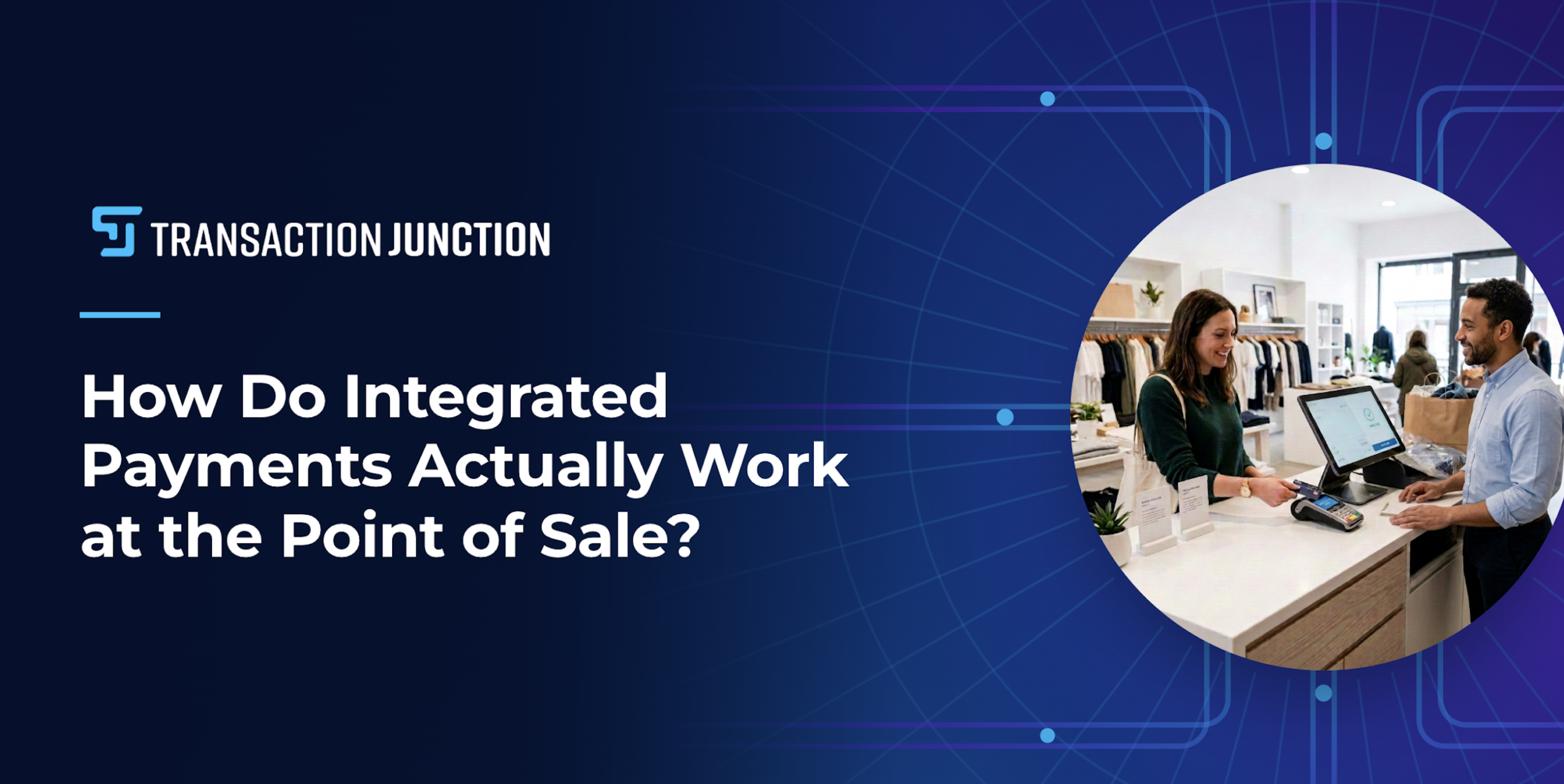
For many retailers, payment acceptance is still treated as an afterthought, the last, forgettable step in a sale. Properly integrated, it becomes something else entirely…
The difference between a stand-alone and integrated payment shows up in two key places: how a payment is actually processed, and how transactions are reported on the back-end. Get both right, and a business barely has to think about payments at all.
One FinTech built around exactly that idea is Transaction Junction (TJ), a Southern African company with a speciality in point-of-sale (POS) integrations.
What Actually Happens Behind the Payment
Without integration, the point of sale and the card machine work independently. The cashier has to key the amount into the card machine by hand, and every manual entry is a chance to accidentally overcharge or undercharge a customer.
With integration, the same transaction becomes one connected process, removing every manual step between scanning an item and taking payment:
- Items ring up as usual. The cashier scans products, and they appear on the point of sale as normal.
- The cashier presses Payment. One action on the till screen, when payment is needed.
- The amount is sent to the terminal automatically. Software pushes the exact figure from POS to card terminal, no manual amount entry.
- The customer pays, by card, wearable or digital payment, whichever the merchant has activated.
- Confirmation displays automatically, on both the till and the terminal.
- Receipts print and the sale closes itself, no extra action needed from the cashier.
- The transaction is reported and reconciled, visible in the customer portal the moment it happens.
HOW IT WORKS – WATCH THE VIDEO: https://www.youtube.com/watch?v=VtWT2EBr7mo
Removing that manual amount entry step matters: it eliminates the chance of mis-charging customers and reduces the checkout time. The customer only notices a faster payment; the real value happens behind the scenes.
That includes security. Every transaction runs through PCI-validated processing that protects against cyber-crime.
Always Know How the Business Is Doing
As a business grows, manual processes get expensive fast. Relying on several disconnected systems to understand store performance means more time spent compiling reports, and less time acting on what they show. TJ’s customer portal solves that. It’s a real-time web-based portal that puts every transaction, from every store and till, into one place: searchable, and exportable to PDF, CSV or Excel whenever it’s needed.
Whether a merchant needs visibility for two card terminals in one store, or 10 card machines across 200 stores, the portal is built for that scale.
Know That the Money Actually Arrives
Reconciliation means checking that the money a business thinks it made actually lands in its bank account: matching what the till says was sold against what the bank recognises, transaction by transaction.
Without integration, that check happens by hand, usually once a month: a finance professional compares till records against bank statements line by line. A sale that never settled, or an amount that doesn’t quite tally, can sit unnoticed for weeks, and every manual step is also a chance for error or fraud to slip through.
With integration, that checking runs automatically and continuously. The point of sale’s record, the bank’s record and the payment switch’s own record are checked against each other in real time, so any gap is flagged the moment it happens, not a month later. Once flagged, exceptions are easy to resolve.
What This Means for Merchants
“The difference between an integrated payment solution and a stand-alone payment terminal isn’t just about technology,” says Adele de Villiers, Head of Sales and Key Accounts at Transaction Junction. “It’s about operational efficiency, financial visibility, and creating a better customer experience.”
Part of that is banking flexibility. TJ’s platform is built to stay, in her words, “device- and bank-agnostic,” so merchants never have to change banks to use it. In practice, that means integration into more than 95 point-of-sale systems, support for whichever acquiring bank a merchant already uses, along with set monthly fee for in-person payments rather than a charge on every transaction, a meaningful difference for a retailer who wants predictable costs.
Behind all of this is a bigger shift in how Southern African retail is being built. The businesses pulling ahead are treating payment acceptance as core infrastructure, not an afterthought: fast, secure, visible and accounted for in real time, rather than stitched together after the fact. Integration makes that possible at the till. Visibility and reconciliation make it trustworthy everywhere else. Together, they are the standard a modern business is expected to meet.
Getting Started with Transaction Junction
Established in 2007 and headquartered in South Africa, Transaction Junction (TJ) is a leading fintech company that provides a modern transaction platform to businesses across numerous industries, whether operating in-person, online or hybrid.
Visit transactionjunction.za/contact/ and complete the form to get started.