
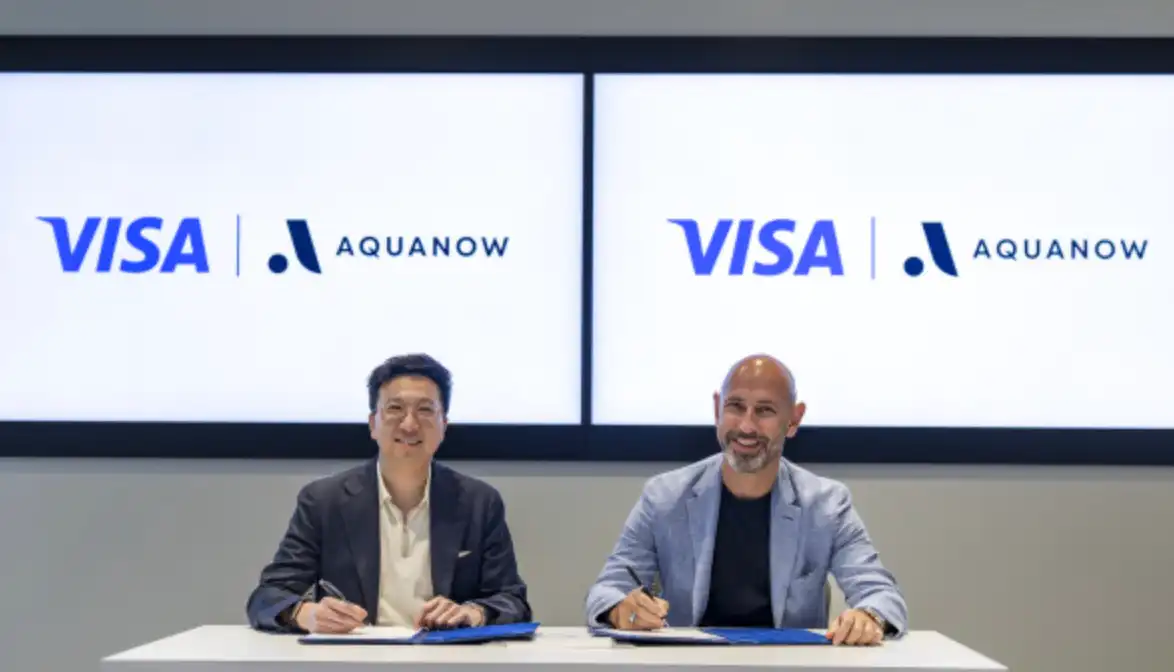
Visa, a global leader in digital payments, has announced the expansion of its stablecoin settlement capabilities across the Central and Eastern Europe, Middle East, and Africa (CEMEA) region.
This development comes through a new partnership with Aquanow, a digital assets platform known for its liquidity expertise and blockchain infrastructure solutions. The collaboration represents another step in Visa’s long-term strategy to modernise settlement, reduce operational friction, and support faster cross-border value movement for financial institutions.
The partnership integrates Aquanow’s digital asset infrastructure directly into Visa’s technology stack. Through this connection, issuers and acquirers in the CEMEA region will gain the ability to settle transactions using approved stablecoins, including USDC. Using a stablecoin for settlement can significantly reduce the complexity often associated with traditional settlement processes, which typically involve several intermediaries, limited operating hours, and delayed reconciliation cycles. By offering an always-on digital settlement option, Visa is positioning its network to support faster, more transparent, and more cost-efficient money movement.
Demand for improved settlement methods has risen sharply as financial institutions seek ways to accelerate cross-border flows and improve liquidity management. Traditional settlement rails were not designed for the pace of today’s global commerce. They often pause on weekends or holidays and require manual intervention from multiple parties. By enabling stablecoin settlement, Visa is helping institutions overcome these limitations, offering a digital pathway that supports continuous, 365-day settlement.
Visa began exploring this capability in 2023, when it piloted a programme allowing selected clients to use USDC to fulfil their settlement obligations. The pilot demonstrated strong interest among banks and fintechs, many of which are looking for ways to integrate blockchain-based efficiencies without compromising regulatory or operational standards. Since launching the programme, Visa’s stablecoin settlement volumes have grown significantly, now exceeding a $2.5 billion annualised run rate. This momentum highlights how quickly institutional adoption of digital settlement options is gaining traction.
Godfrey Sullivan, Head of Product and Solutions for CEMEA at Visa, emphasised the importance of this evolution. He explained that pairing stablecoin functionality with Visa’s trusted global network gives financial institutions access to faster and simpler settlement workflows. According to Sullivan, reducing reliance on older systems with multiple intermediaries helps prepare institutions for the future of money movement, where digital and traditional rails will operate more closely together. The partnership with Aquanow, he noted, is a meaningful step toward modernising the backbone of payments in regions that are rapidly digitising.
Aquanow’s CEO, Phil Sham, also highlighted the impact of the collaboration. He noted that Visa has an extensive history of facilitating secure and efficient global transactions. By integrating stablecoin settlement options, the two organisations are enabling institutions to participate more actively in the digital economy. Sham underscored that using internet-native money allows value to move with greater transparency and speed, giving organisations more predictable settlement outcomes and improved control over their liquidity.
Beyond operational improvements, this expansion represents a broader shift in how global financial infrastructure is evolving. Stablecoins, which combine the programmability of digital assets with the stability of fiat currency, are emerging as an essential tool for improving cross-border settlement and treasury operations. By offering stablecoin settlement on its network, Visa is helping financial institutions adopt these innovations in a compliant, integrated, and scalable way.
As global commerce accelerates and the demand for real-time settlement grows, Visa’s partnership with Aquanow demonstrates how established payment networks can embrace emerging technologies to upgrade their core capabilities. The move reinforces Visa’s commitment to supporting a more connected and efficient financial ecosystem, one where digital assets and traditional currencies coexist to deliver faster, safer, and more cost-effective ways to move money.